
Renault · OBD-II
Renault Clio 5 (2019 - ...) — Where is the OBD-II port?
Below the dashboard, driver area
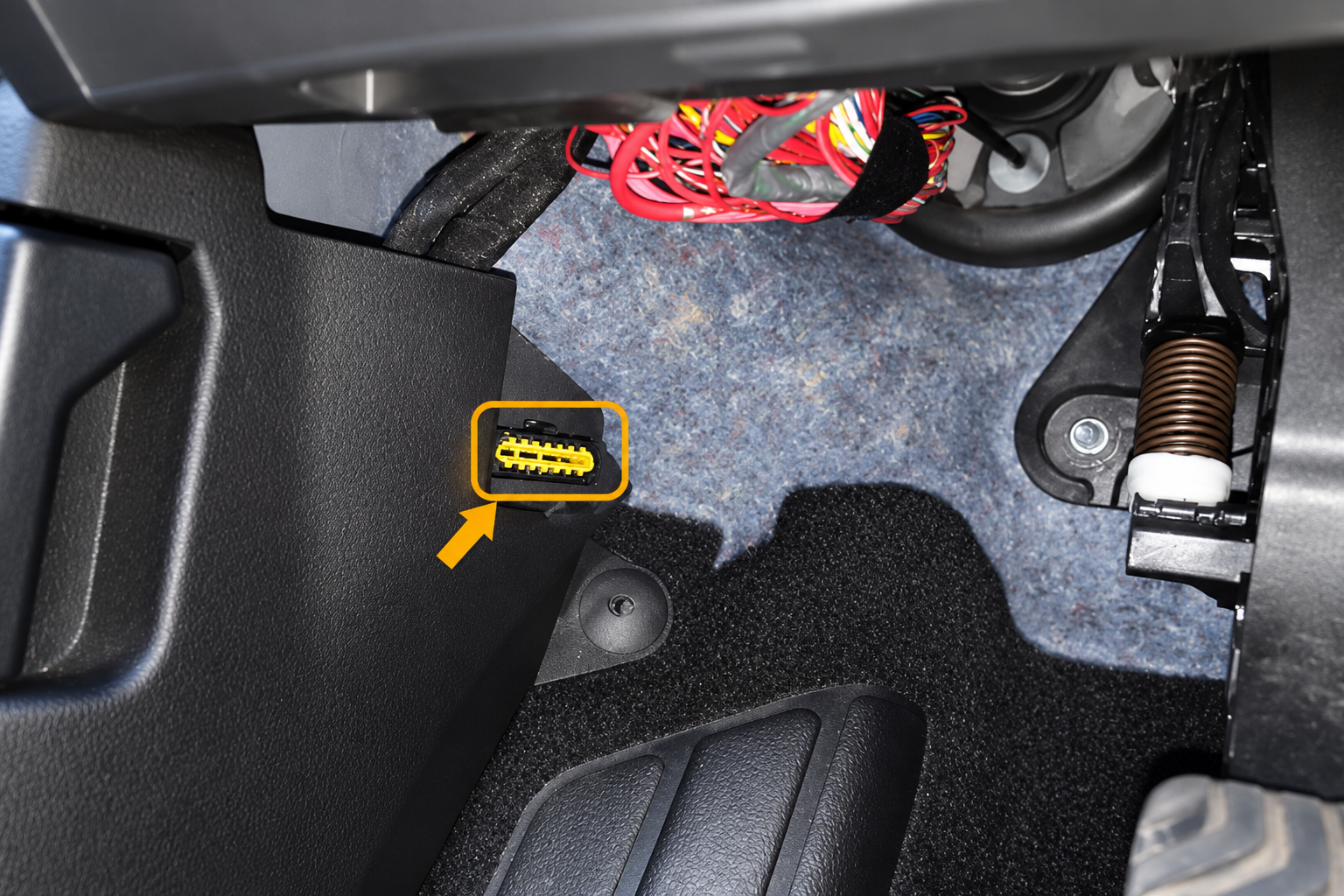
How to find it
- Check the generation and year range above. Dashboard design and location can vary by market and version.
- Below the dashboard, driver area. Source landmarks: footrest.
- Use a torch to identify the socket. Do not dismantle the dashboard to search for it.
- Identify the trapezoidal 16-position socket. Switch the ignition off before connecting an adapter, then follow the scanner instructions.
Source and identification documentation
Source: Klavkarr / Outils OBD Facile. Accessed 29/10/2026. Check the documentation against your vehicle configuration before connecting.
View source photographsSource directions (English)
- The OBD II plug is located at the bottom left of the steering wheel
- The OBD port is visible above the footrest
- Here the OBD port
Looking for a sensor?
Sensor positions depend on the engine code. For DPF, EGR, MAF or MAP components, use documentation for the exact engine. We do not infer location from model alone.
Manuals and documentationSensor orientation guides · MAF, MAP, EGR and DPF
General orientation only, NOT verified locations for a specific vehicle. Exact identification requires engine code, year and technical documentation.
MAF · Mass airflow sensor
Usually on the intake duct after the air filter and before the turbo or throttle, if fitted.
MAP · Manifold pressure sensor
Usually on the intake manifold or charge-air pipe. A separate boost pressure sensor may also be fitted.
EGR · Exhaust gas recirculation valve
Near the exhaust-to-intake recirculation path; some engines have EGR coolers and multiple circuits.
DPF · DPF differential pressure sensor
Often in the engine bay or underbody, connected by two small pressure lines across the particulate filter. Exact placement depends on engine.
Do not disconnect sensors, DPF lines or hot components to identify them. Codes are diagnostic examples, not proof of a fault.
Consult manuals for the exact engine →